Improving Parabix Performance on ARM Architecture
Abstract#
This report details our efforts to improve the performance of Parabix, a parallel bitstream framework, on ARM architecture. Parabix leverages Single Instruction, Multiple Data (SIMD) parallel processing to achieve gigabit per second text processing. While Parabix has proven its efficiency on x86 architecture, it did not achieve an equivalent performance on ARM due to the need for architecture-specific optimization required to take full leverage the different SIMD instruction set. In this project we utilize ARM’s advanced SIMD extension, NEON, to improve the performance of Parabix on ARM.
We rewrote functions within the IDISA_ARM_Builder using NEON intrinsics.
Compared to the previous implementation we achieved a 58% speedup on QA tests and
demonstrated a 2% to 32% decrease in CPU cycle counts on individual Parabix tools using our performance testing script.
Additionally, we explored the potential of incorporating ARM’s Scalable Vector Extension (SVE) into Parabix.
Our research involved creating an experimental IDISA_ARM_SVE_Builder and
analyzing the challenges of integrating SVE’s vector-width agnostic programming into Parabix’s existing architecture.
We propose changes to Parabix’s code generation which allow for better support of SVE by decoupling target-specific
implementation concerns.
Our work demonstrates the performance improvements achievable through applying NEON intrinsics and lays groundwork for utilizing SVE within Parabix.
Introduction#
From smartphones to supercomputers, ARM architecture powers an increasingly diverse range of computer devices. As ARM captures a growing market share across embedded systems, mobile devices, and even high-performance computing, it is crucial for software to effectively leverage ARM’s capabilities. While many applications can simply be recompiled for ARM using LLVM, high-performance parallel processing frameworks like Parabix require architecture-specific optimizations to achieve peak efficiency.
This project aims to improve Parabix performance on ARM through application of ARM’s advanced SIMD extension, NEON. Parabix utilizes SIMD to achieve gigabit-per-second text processing speeds. While Parabix has demonstrated impressive efficiency on x86 architectures, its performance on ARM has lagged due to insufficient use of ARM’s unique SIMD instruction set.
NEON offers a powerful set of SIMD intrinsics that can dramatically accelerate parallel computation.
By rewriting functions within Parabix’s ARM-specific builder, IDISA_ARM_Builder,
we aim to close the performance gap between the current implementation and what ARM is capable of.
Our approach focused on identifying opportunities where NEON intrinsics could replace inefficient, generic
operations, while also guaranteeing an entirely correct implementation.
This report details our methodology, implementation, and results in optimizing Parabix for ARM. We begin with an overview of ARM’s growing importance and SIMD efficiency, followed by an exploration of our NEON optimizations. We present rigorous performance measurements demonstrating substantial improvements across various Parabix tools. Additionally, we investigate the potential for incorporating ARM’s SVE into Parabix, laying the groundwork for a future implementation.
Our work not only demonstrates significant performance improvements through ARM NEON optimizations but also provides insights into adapting Parabix for SVE. By improving Parabix’s ARM performance, we extend its applicability to a wider range of devices and use cases, from efficient text processing on mobile devices to high-throughput analysis on ARM-based supercomputers.
Background#
Why ARM?#
ARM architecture powers a diverse range of devices, from efficient smartwatches to the most powerful supercomputers . Designed for efficient computing, ARM is the most popular choice for IoT and embedded devices. However, its applications extend beyond low-power devices. The vast majority of smartphones and tablets rely on ARM’s efficiency to perform power intensive tasks while maintaining a long battery life.
Currently 13% of laptops are powered by ARM, it is estimated that by 2025 ARM will capture 21% of the market .
ARM isn’t only efficient for portable devices. SVE has proven to create efficiency at the largest scales. For instance, Fugaku, the world’s fastest supercomputer from 2020 to 2022, utilized SVE to surpass all other supercomputers.. It is clear that the efficiency and customization of ARM architecture allows it to excel across a wide range of computing applications, making ARM ubiquitous.
Parallelism is fundamental to Parabix. ARM’s strong support for efficient parallelism through NEON and SVE creates an opportunity for Parabix to run efficiently on both smartwatches and supercomputers , something which not feasible on x86.
Efficiency of SIMD#
SIMD (Single Instruction, Multiple Data) is a parallel computing method where a single instruction operates on multiple data points simultaneously, enabling significant speedups compared to scalar execution. However, this efficiency can only be realized when the desired computation is supported by the underlying architecture.
In 2001 ARM introduced the advanced SIMD extension, called NEON. Unlike previous SIMD implementations, NEON’s design allows for easy application to a wide range of problem domains. Notably this project makes use of NEON intrinsics. Intrinsics are pre-defined, architecture-specific functions that map to assembly instructions. This mapping eliminates the need for the translation that occurs with a generic function. Intrinsics also provide the compiler with context that assembly instructions alone do not have. Overall, NEON intrinsics enable programmers with a simple way to implement high efficiency computation.
Project Goals#
Our primary objectives are to improve the performance of Parabix on ARM architecture, ensure the correctness of its implementation, and extend its functionality to leverage the NEON instruction set
Starting State#
In 2022, an attempt was made to write an ARM specific builder for Parabix.
Their ARM builder, IDISA_ARM_Builder, was an adaptation of the already existing IDISA_SSE_Builder.
The adaptation used many architecture-agnostic functions which resulted in an inefficient and sometimes incorrect implementation.
Desired State#
Given this initial state, our primary goals were to ensure a completely correct implementation and to utilize ARM-native features to improve efficiency. These objectives go hand-in-hand, as ARM NEON provides a set of intrinsics that are both guaranteed to be correct and highly efficient.
To achieve these goals, we planned to utilize the existing QA test suite to verify correctness of our changes. Each run of the test suite also reported the duration of each test, providing a general idea of efficiency improvements. However, for more accurate statistics, we planned to create a performance testing script. The script would run a small subset of Parabix’s tools multiple times while recording wall-clock time and CPU cycle counts. Allowing for an accurate understanding of our improvements.
Finally, after successfully applying NEON intrinsics, we planned to explore the viability of using NEON’s SVE to achieve further performance increase.
Project Design#
Build and Execution Environments#
Building Parabix for ARM presented the challenge of running ARM architecture on our x86 machines. Without access to ARM hardware we planned to use the emulator QEMU . QEMU offers a complete ARM system emulation allowing us to to execute ARM binaries, even with ARM specific extensions like SVE, on x86 hardware.
IDISA_ARM_Builder#
In Parabix, operations such as a vector shuffle are first defined in an architecture-agnostic way. This ensures that Parabix can run on any architecture LLVM supports. However, because these function definitions cannot utilize architecture-specific features, their implementations are often inefficient. To address this, Parabix allows specialized architecture-specific builders to override the general implementation. In particular, the ARM builder overrides how SIMD operations are defined on ARM.
We researched the available NEON intrinsics and identified candidate matches to the IDISA Builder functions.
For some functions, such as mvmd_slli, mvmd_srli, and mvmd_dslli, LLVM doing the work for us by replacing
the generic calls with NEON intrinsics. Other functions such as mvmd_compress, hsimd_signmask, and bitblock_advance
had no suitable translation into NEON intrinsics, so their implementations were removed from the builder.
The following are the remaining functions, along with a description of the NEON intrinsics used to implement them:
-
simd_bitreverserbitreverses the bits in each byte of the vector.rev16torev64will reverse the bytes within each 16 to 64 bit field. -
esimd_mergelandesimd_mergehzip1andzip2provide the same functionality asmerge. -
hsimd_packlandhsimd_packhuzp1anduzp2provide the same functionality aspack. -
simd_popcountcntgives a population count for bytes in a vector.addpreduces the vector to the appropriate field width and element count.
Measuring Improvements#
The overarching goal for this project is to demonstrate an improvement in performance so accurately tracking Parabix tool performance is important. We planned to create a performance testing script written in either Bash or Python. The script would run a small subset of Parabix’s tools and capture CPU cycle counts using Parabix’s debug flags.
Implementation#
Development Environments#
QEMU’s ARM system emulation was accurate but slow. To mitigate long build times within the emulator, we opted to cross-compile Parabix on our x86 machines. However, even running the pre-compiled binaries proved too time-consuming. To address this, we acquired a Raspberry Pi 5, which uses the Armv8-A processor, enabling us to build and run Parabix on physical ARM hardware.
The only downside to using physical hardware over emulation was that Raspberry Pi’s SoC, Broadcom BCM2712, opted to not include ARM’s SVE extension . To work around this we employed QEMU’s user-mode emulation to emulate SVE.
All performance results presented in this report were obtained using the Raspberry Pi 5 running Raspberry Pi OS.
IDISA_ARM_Builder#
To demonstrate the changes made throughout the IDISA_ARM_Builder we highlight one function, esmid_mergel
Previous implementation#
esmid_mergel was written with generic function calls such as smid_or. The implementation was
also not compete as it only handled the special cases where field with was equal to 1 or 2. In all other cases
this function simply called the default builder to do the computation.
In all cases this function generated inefficient function calls.
Our implementation#
After researching NEON intrinsics we found one called zip1 which performs the exact computation needed
for esmid_mergel.
We replaced the previous implementation with a single function which simply calls zip1.
The complete function is shown in the code snippet below. Note that our implementation handles the common field width
sizes from 16 to 64, but similar to the previous implementation, calls the default builder when given a field width
outside that range. This is common for all builder functions to ensure that any given field width is correctly computed.
esmid_mergel is a fortunate case where a single NEON intrinsic computed the desired computation,
most functions required the use of multiple intrinsics.
Value * IDISA_ARM_Builder::esimd_mergel(unsigned fw, Value * a, Value * b) {

  if ((fw >= 16) && (fw <= 64) && (getVectorBitWidth(a) == ARM_width)) {

  int nElms = getVectorBitWidth(a) / fw;
  int halfFw = fw / 2;

  Function * zip1_fn = Intrinsic::getDeclaration(getModule(),
    // Call to ARM NEON intrinsic
    Intrinsic::aarch64_sve_zip1,
    FixedVectorType::get(getIntNTy(halfFw), nElms * 2));

  return CreateCall(
    zip1_fn->getFunctionType(),
    zip1_fn,
    {fwCast(halfFw, a), fwCast(halfFw, b)});
  }
  return IDISA_Builder::esimd_mergel(fw, a, b);
}
Rewrite of esmid_mergel to use the NEON zip1 intrinsic.
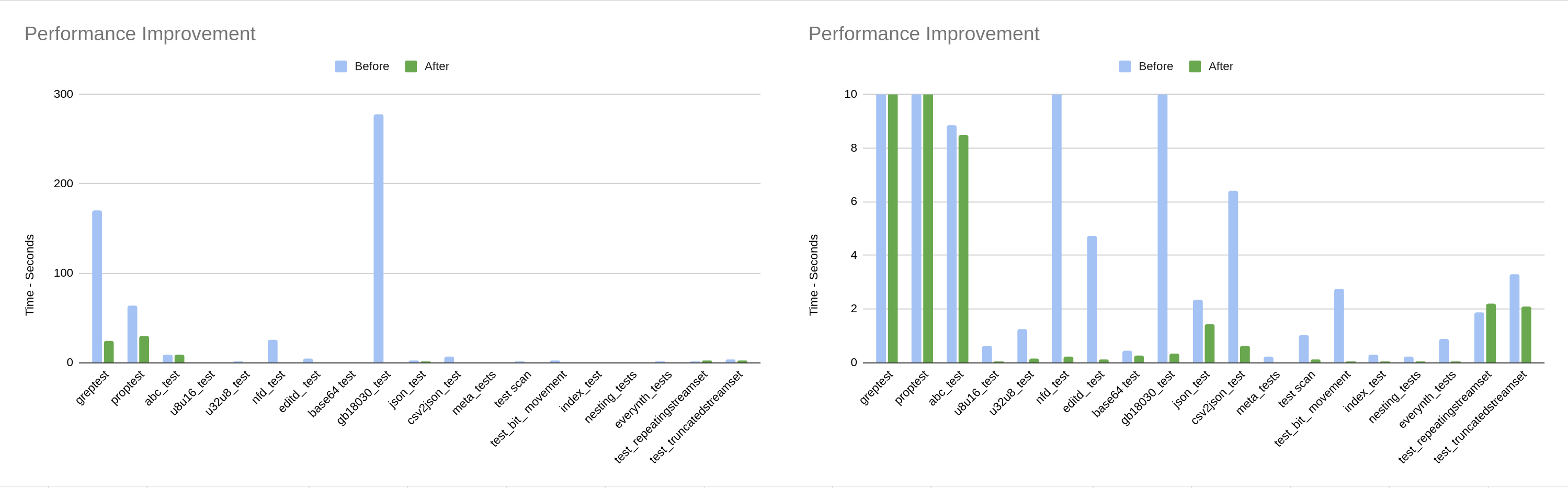
The same data is displayed in both figures. The left has a time scale of 30 seconds, the right a
scale of 2.5 seconds. Note that two tests, greptest and editd_test, are not included
because they failed in the previous implementation.
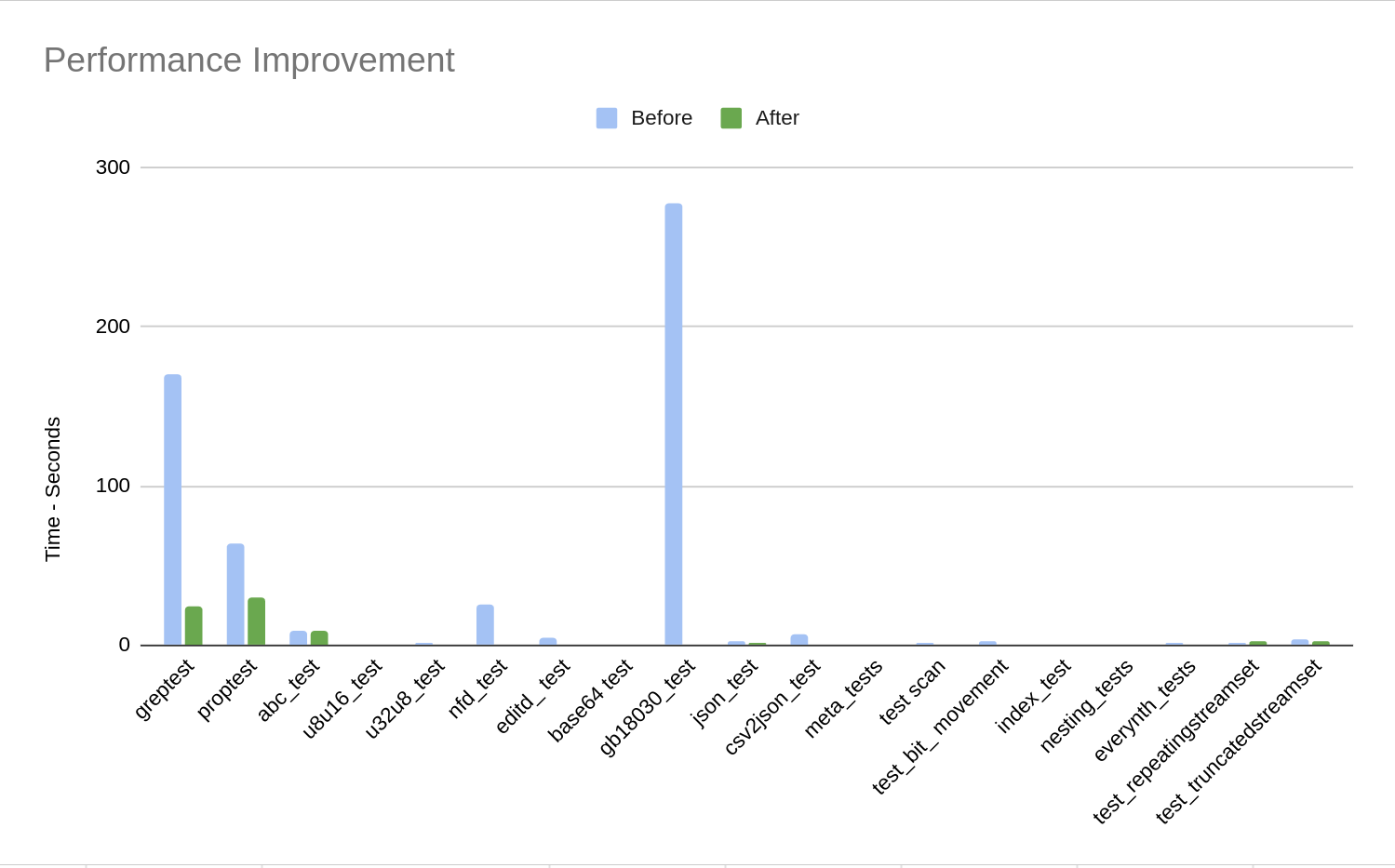
This data demonstrates that our changes have a made an improvement in performance
across every test.
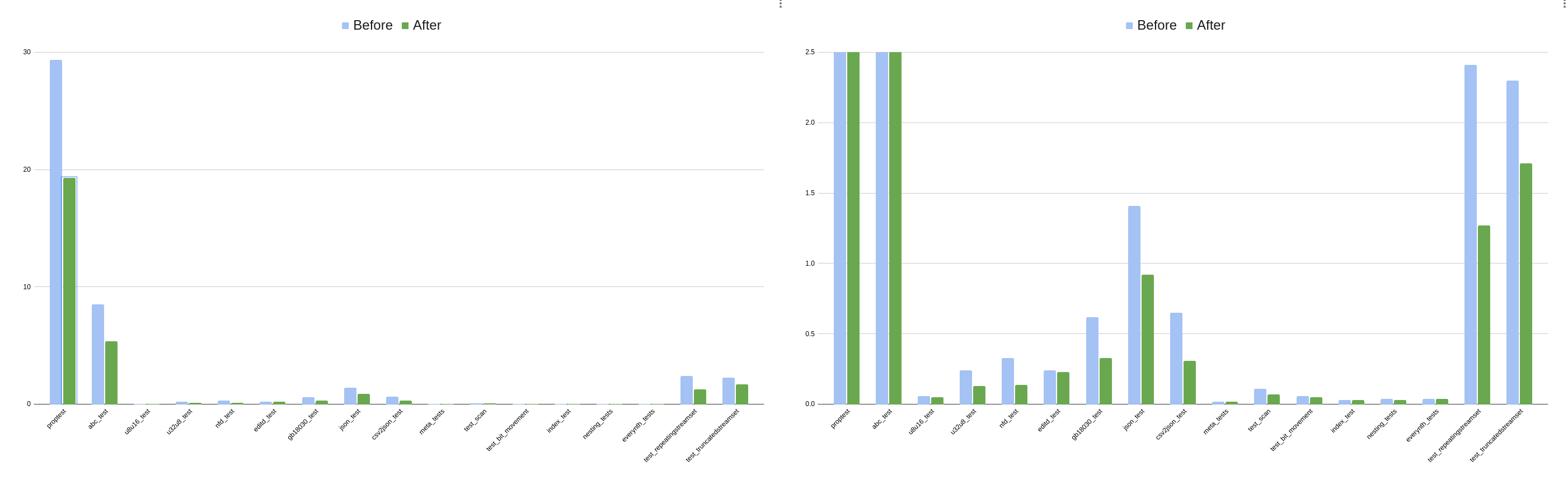 Results of
 make test before and after our changes.
Cycle Counts#
Written in Python, the performance testing script calls Parabix tools icgrep, wc, and csv2json
and gives them large files as input.
We pass the debug flag -EnableCycleCounter to capture the number of CPU cycles used by each
by each kernel, which is essential for accurately measuring our performance improvements.
Parabix also automatically caches kernels to improve run time.
To ensure that successive test with small changes were not affected by what was stored in the cache
and smooth variance in the run times
we used a second debug flag --enable-object-cache=0 which disables the object cache.
The test script runs each tool 10 times to smooth out variance resulting from CPU and IO caches warming up. For each run, it captures the cycle counter report and computes an average of the cycle count totals by kernel across all runs. We found that the script gave us very repeatable measurements.
By our measurements, we reduced the total average cycles used by icgrep by 32.4%,
the cycles used by wc by 11.4%, and the cycles used by csv2json by 2%. GNU
perf measurements showed an increase from 180 MB/s to 283 MB/s IO bandwidth for icgrep,
379 MB/s to 571 MB/s for wc, and 108 MB/s to 113 MB/s for csv2json.
The numbers from icgrep and wc are encouraging, and we were glad to see that the two
tools used to measure confirm that we’re spending less time on each item and so getting through
the entire stream faster. The numbers we measured from csv2json, however, are in the noise.
The operations we were able to optimize on ARM platforms – pack, merge, popcount, etc. – are operations
that icgrep and wc both rely heavily on. csv2json, however, performs
many deletions and insertions, and relies most heavily on bitwise compress-right and expand-right
(pext and pdep. Without hardware support these operations are slow on ARM platforms,
and so there was not much we were able to do to improve them.
Scalable Vector Extensions (SVE)#
SVE Overview#
SVE is an optional extension in the ARM architecture introduced in ARMv8.2-A . It allows for vector registers to be implemented using widths from 128-2048 bits with the only restriction that the chosen width is some multiple of 128. To support this, SVE defines a vector instruction set and programming paradigm for writing code that is vector-width agnostic. SVE aims to give hardware manufacturers some freedom in choosing how wide to implement their processor’s vector registers while giving software developers the ability to run on any processor that includes SVE regardless of the actual vector width. In addition to variable-width vector registers, the SVE architecture adds a set of predicated instructions, gather-loads and scatter-stores, and new instructions for horizontal vector reduction operations.
SVE’s vector width-agnostic programming paradigm is achieved largely through instruction predication and a set of predicate generation functions. Consider as an example the following simple example:
*Simple loop example pseudocode would usually be quite simple:
load strides of the vector register width into vector registers from x and y, use
SIMD operations to perform multiplication and addition, and store in strides to result.
SVE presents a unique challenge given that we do not know at compile time what the
vector width will be. We can vectorize the given operations in a vector width-agnostic way by
using two tools given by SVE: first, we can find how big the stride should be using one of the
cnt* instructions provided by SVE to get the count of elements in a vector at run-time;
second, we can use either use the runtime vector width to correctly scalaraize the tail or use
vector predication to load and operate on the correct number of elements in the loop’s tail.
SVE provides a set of looping instructions that, given a loop index and
a total number of elements, create a predicate register for different termination conditions.
For example, whilelt creates a predicate vector with active elements up to the point
that the loop index becomes greater than or equal to the total.
The looping strategies presented here illustrate the key way that SVE’s vector width-agnostic programming functions: it relies on moving values that were previously known at compile time to run time. This has implications not just on loading, storing, and handling vectors, but also in computing constant mask values or constant vectors. It’s impossible to specify a scalable constant vector. Instead, they need to be computed at run time.
SVE promises to give performance gains by and increased SIMD throughput, however it has yet to see widespread adoption. Apple Silicon’s M-series processors do not implement SVE, and it appears that the Cortex-A710 ARMv9 processor is among the first Cortex processor to offer SVE, albeit with a vector width of only 128 bits. It’s difficult to find comprehensive information on chipsets that implement SVE, but it appears the cloud computing space is the only space where SVE is easily accessible; Amazon’s ec2 has virtual machine offerings running on their in-house ARM processors with SVE support .
Scalable Vectors in LLVM#
LLVM introduced new types and intrinsics for supporting SVE and scalable vector architectures.
Scalable vectors are written as <vscale x N x Ty> where:
vscaleis a placeholder for a vector length multiplier known at run timeNis the minimum number of elements of typeTythe vector can holdTyis the numeric type of the elements of the vector
SVE vectors must be some multiple of 128, so legal SVE vectors could be <vscale x 16 x i8>,
<vscale x 2 x i64>, or any other vector where N times the width of Ty equals
128.
Supporting SVE in Parabix#
Experimental IDISA_ARM_SVE_Builder#
Our project submission includes an experimental IDISA Builder targeting SVE. Our builder is quite minimal; it only implements Parabix pack operations using scalable vector types. It serves only to prove that we can select the SVE implementation when SVE is available and emit code that uses scalable vectors. As such, it doesn’t support SVE in any practical or performant way.
*Implementation of the packl function for SVE shows the implementation of the packl function. It converts between the fixed vector type used elsewhere throughout Parabix and the scalable vector type required to call the SVE intrinsics provided by LLVM. Inspections of the generated assembly reveal that LLVM scalarizes the loads and stores; in fact, LLVM loads the scalable vector register a byte at a time. Clearly, this approach is not ideal.
Our implementation also includes a function pass to try and help LLVM choose to use scalable vectors
when the fixed vectors its using would fit. Our pass adds the vscale_range attribute to each
kernel function which hints to LLVM that the scalable vector’s vscale parameter will be within
the given range and enables it to store fixed vectors in scalable vector registers when legal and
perform optimizations using scalable vector types. In practice, however, we did not find that LLVM
chose to do so.
Parabix’s current code generation architecture#
Parabix programs comprise kernels and stream sets. Stream sets, internally, are managed buffers of data that are loaded into SIMD registers for parallel processing by kernels. Kernels can generate the machine code to operate on stream sets by using a KernelBuilder to generate LLVM IR directly or by using a PabloBuilder to generate a Pablo Abstract Syntax Tree (PabloAST). The PabloCompiler will then use a KernelBuilder to transform the PabloAST into LLVM IR. Parabix is also capable of compiling regular expressions to machine code capable of matching the expressions against data in a stream set. Regular expressions are compiled by generating Pablo code that performs the match at compiling it.
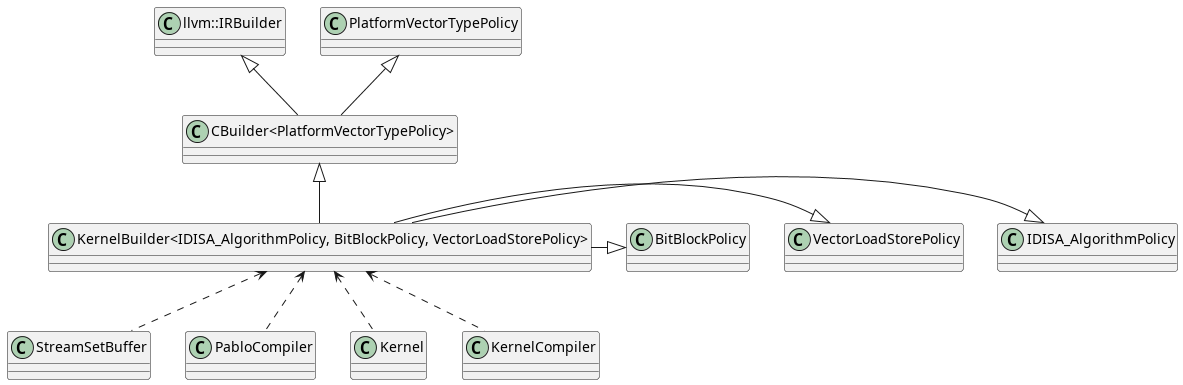
The main entry point to the codegen layer is, then, the KernelBuilder. the figure below shows the inheritance chain culminating in the KernelBuilderImpl class that is consumed by all higher-level application layers.
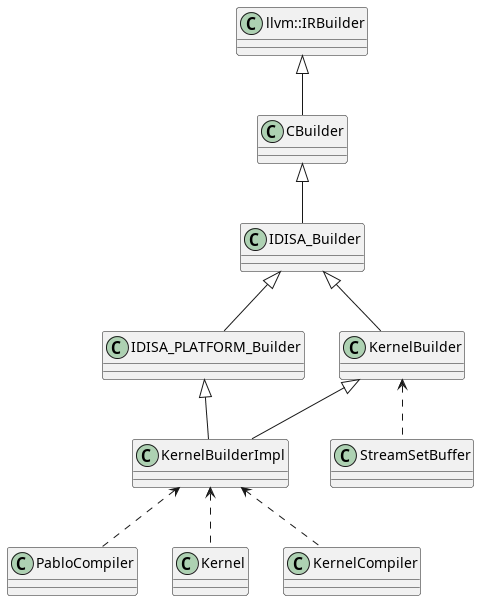 KernelBuilderImpl inheritance tree.
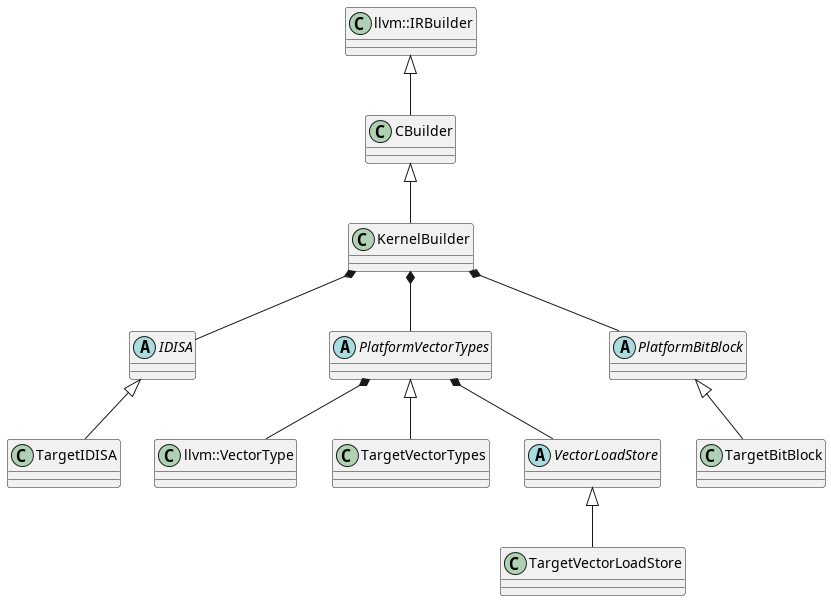 Proposed composition-based target codegen architecture.
Conclusion#
Our project has been quite successful in meeting its goals. We were able to take the existing ARM implementation and mature it into an implementation that is correct and performant. We did this by identifying candidate IDISA operations that would benefit from the set of operations that NEON supports natively and implementing them using NEON SIMD instructions. Although not every candidate operation we identified ended up benefiting from NEON, we are satisfied with the breath of operations we did implement and we were able to verify for some that LLVM was already emitting optimal code for the default implementations. We were also able to take good performance measurements and quantify what the performance gain was to get a sense of which use cases benefited the most from our work and which benefited the least.
Using the time we had left over in the project term we were able to begin investigations into SVE and assess how vector width-agnostic programming could be enabled in Parabix in the future. In the course of this work we identified potential architecture improvements that could be made to Parabix’s codegen layer to enable easier implementation of support for new target architectures in the future.
Lessons Learned#
Throughout the project, we encountered several valuable lessons and insights. This project and, more generally, this course has demystified SIMD programming for us. Conceptually, SIMD programming is not a difficult thing to understand, but we now understand better how to reason about vectorized code, evaluate efficiency, and come up with more optimal solutions to problems. We have also gained a good sense of what kind of higher-level code is easily vectorizable by a compiler which will enable us to better reason about the performance characteristics of higher-level code and write more performant code more often.
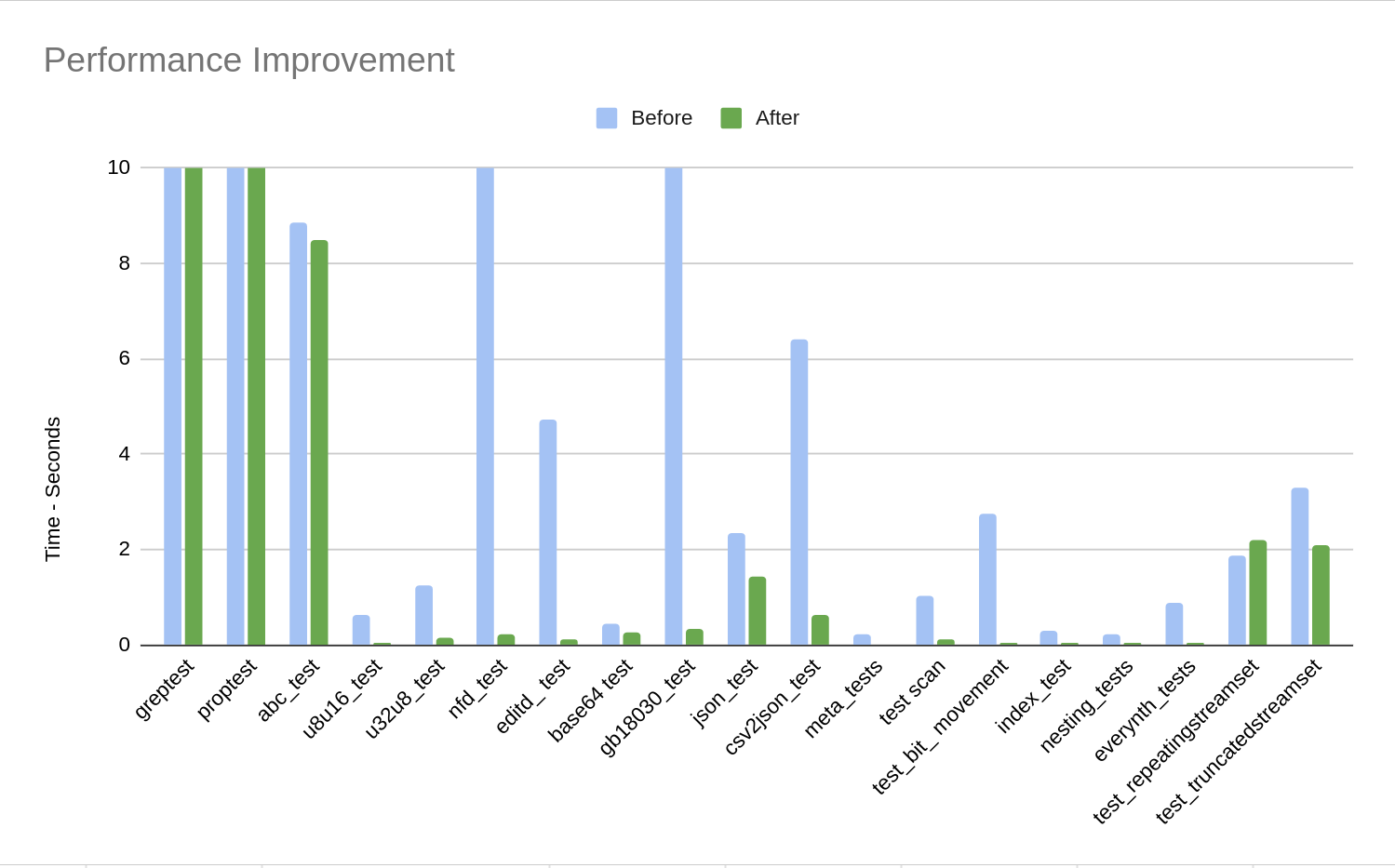
Measuring performance was also a big part of our project. Initially when comparing our implementation
to the previous using make test we saw an extreme boost in performance. These
were part of the results presented in the poster presentation. While these results were true, they
weren’t completely fair. Unlike our performance script make test does not circumvent caching.
After accounting for caching we found that our changes made consistent improvement but not as
extreme as we initially thought. Further, measuring wall-clock time is not always a meaningful
measure of performance, and a good performance measuring system should look at several different
metrics across several different use cases of the software its measuring to build a more
holistic assessment.
Early in the project we used QEMU to create virtualized ARM enviroments for us to work in. QEMU is impressively consistent in it’s emulation. For example subtle bugs which we encountered within emulation were reproduced on hardware. The downside to QEMU was just how slow the system emulation was and how long of a development cycle it created. We underestimated how much this would hinder our ability to make progress.
Working so closely with LLVM IR presented us with a steeper learning curve to overcome in the early phases of the project. LLVM IR’s similarity to assembly language can sometimes obscure the fact that it’s still a deep abstraction over the machine code you wish it to generate. For our use case, we wanted LLVM to emit specific sequences of instructions for each operation we implemented. In some cases that proved difficult. We learned that in these cases we had to instead write code from which LLVM could easily infer what our intent was; we had to give it more space to “do the right thing”.
We’re glad to have chosen a project that required us to work so closely with back-end compiler technologies. Working at this level and learning the Parabix codebase has helped us understand how to go about integrating a back-end into a compiler. The experience gained will serve as a good foundation for future compiler projects.
Future Work#
We see little in the way of future improvements that could be made to Parabix’s NEON support. The NEON instruction set is relatively simple as SIMD instruction sets go, and we don’t see much more that can be improved with what it has to offer. We did find that the bitwise compress-right and expand-right (pext/pdep) operations were very slow on ARM, however we did not have enough project bandwidth to dedicate time to improving them. It still may be worth evaluating other algorithms to perform these operations. Some Parabix tools such as csv2json use these operations extensively, and for these tools there are big performance gains to be had by improving the algorithm for architectures where hardware support is unavailable.
Our project submission includes an experimental IDISA SVE Builder that proves that we can detect the availability of SVE and emit SVE code. As discussed, it does not have usable performance and could take advantage of more of the features that SVE provides. Further work is needed to build out and mature the implementation.
To that end, we’ve also discussed how SVE breaks some of the assumptions made about targets by Parabix’s existing codegen layer and, to a lesser extent, the rest of the Parabix codebase. Enabling vector width-agnostic programming in Parabix will mean refactoring the codebase to use LLVM’s VectorType superclass to polymorphically work with both fixed and scalable vectors.
In this report, we have presented a proposed architecture change to Parabix’s codegen layer to support the effort to support vector width-agnostic programming and to allow more flexibility along the axes on which targets may differ. While the proposed updates would require updating many parts of the Parabix codebase they should be comparatively simple to implement as they are largely a reorganizing effort. The efforts to support both SVE and NVPTX would both benefit from the proposed changes should they be chosen for adoption.
Repository link and note about submission#
The repository can be found here: https://cs-git-research.cs.sfu.ca/sla489/parabix-devel
Please note that we did not merge our SVE experimentation into the master branch as it is experimental
and unstable. It is located in the repository under the sve branch, or the final-sve tag.
Additional Figures from the Source Archive#
 AI
AI
 Perf 10s
 Perf Both
 Perf max
 frog
frog
 frog2
frog2
 parabix policyarch
test both